missing translation for 'onlineSavingsMsg'
Learn More
Learn More
Invitrogen™ Phospho-CREB (Ser133) Monoclonal Antibody (M415)
Description
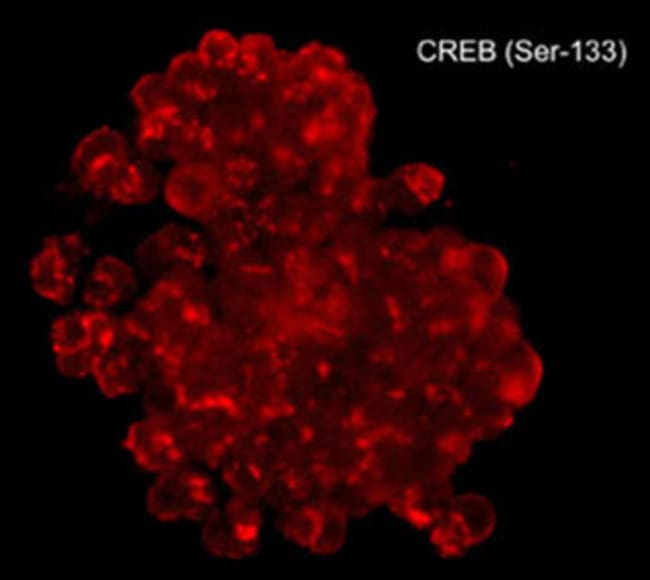
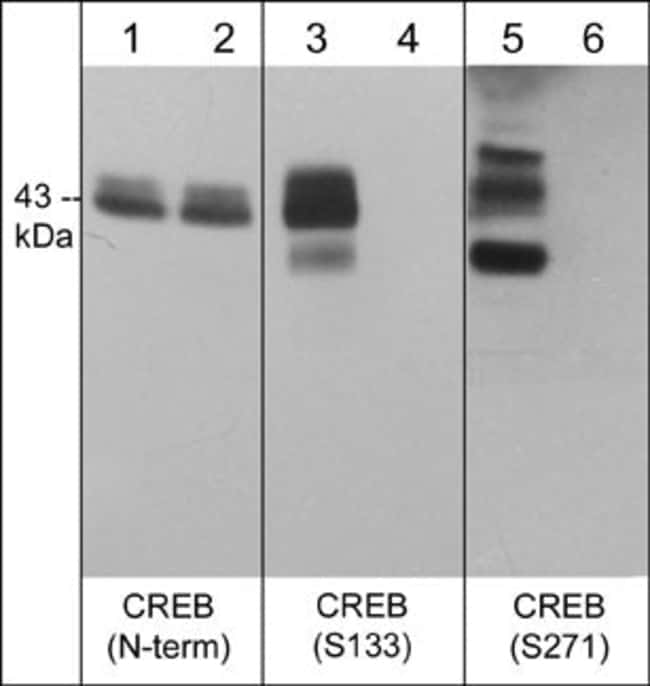
The antibody detects a 43 kDa* protein corresponding to the molecular mass of CREB on SDS-PAGE immunoblots of human A431, Jurkat, and rat PC12 cells treated with Calyculin A, as well as A431 treated with EGF and PC12 treated with NGF or Forskolin. This reactivity is not observed after lambda phosphatase treatment.
CREB (Cyclic AMP response element binding protein) is a 43 kDa basic/leucine zipper transcription factor that binds the cyclic AMP response element (CRE) and activates transcription in response to a variety of extracellular signals including neurotransmitters, hormones, membrane depolarization, and growth and neurotrophic factors. Activation of CREB is dependent upon the phosphorylation of serine 133. Phosphorylation of CREB occurs via p44/42 MAP kinase and p90RSK, and via p38 MAP kinase and MSK1. Although CREB will bind DNA independent of its phosphorylation state, only the phosphorylated form is competent as a transcription factor. CREB binding protein (CBP), a transcriptional coactivator that directly interacts with CREB, binds to CREB in the region of serine 133. CREB is involved in different cellular processes including the synchronization of circadian rhythmicity, differentiation of adipose cells, and learning and memory. In humans, the gene is located on the q arm of chromosome 2. Diseases associated with CREB dysfunction include Alzheimer's Disease, histiocytoma and soft tissue melanoma.

Specifications
Specifications
| Antigen | Phospho-CREB (Ser133) |
| Applications | Western Blot, Immunocytochemistry |
| Classification | Monoclonal |
| Clone | M415 |
| Concentration | ~0.5 mg/mL |
| Conjugate | Unconjugated |
| Formulation | PBS with 1mg/mL BSA, 50% glycerol and 0.05% sodium azide |
| Gene | CREB1 |
| Gene Accession No. | P15337, P16220, Q01147 |
| Gene Alias | 2310001E10Rik; 3526402H21Rik; active transcription factor CREB; AV083133; cAMP response element binding protein 1; cAMP responsive element binding protein 1; cAMP-response element-binding protein-1; cAMP-responsive element-binding protein 1; CREB; CREB1; Creb-1; cyclic adenosine 3',5'-monophosphate response element-binding protein CREB; cyclic AMP-responsive element-binding protein 1; htCREB; MGC9284; OTTHUMP00000206661; OTTHUMP00000206662; OTTHUMP00000206667; transactivator protein; Y protein |
| Show More |
Product Title
By clicking Submit, you acknowledge that you may be contacted by Fisher Scientific in regards to the feedback you have provided in this form. We will not share your information for any other purposes. All contact information provided shall also be maintained in accordance with our Privacy Policy.
Spot an opportunity for improvement?