missing translation for 'onlineSavingsMsg'
Learn More
Learn More
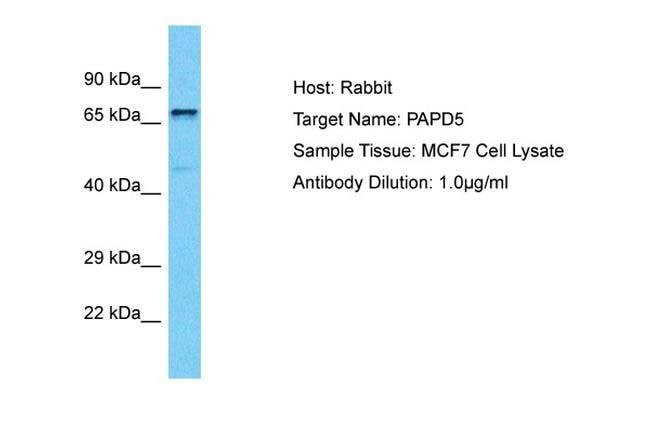
Invitrogen™ PAPD5 Polyclonal Antibody

Description
Peptide sequence: SSSKGFQGTT QTSHGSLMTN KQHQGKSNNQ YYHGKKRKHK RDAPLSDLCR Sequence homology: Cow: 100%; Dog: 100%; Guinea Pig: 100%; Horse: 100%; Human: 100%; Mouse: 92%; Rat: 100%.
Terminal nucleotidyltransferase that catalyzes preferentially the transfert of ATP and GTP on RNA 3' poly(A) tail creating a heterogeneous 3' poly(A) tail leading to mRNAs stabilization by protecting mRNAs from active deadenylation (PubMed:21788334, PubMed:30026317). Also functions as a catalytic subunit of a TRAMP-like complex which has a poly(A) RNA polymerase activity and is involved in a post-transcriptional quality control mechanism. Polyadenylation with short oligo(A) tails is required for the degradative activity of the exosome on several of its nuclear RNA substrates. Doesn't need a cofactor for polyadenylation activity (in vitro) (PubMed:21788334, PubMed:21855801). Required for cytoplasmic polyadenylation of mRNAs involved in carbohydrate metabolism, including the glucose transporter SLC2A1/GLUT1 (PubMed:28383716). Plays a role in replication-dependent histone mRNA degradation, probably through terminal uridylation of mature histone mRNAs. May play a role in sister chromatid cohesion (PubMed:18172165). Mediates 3' adenylation of the microRNA MIR21 followed by its 3'-to-5' trimming by the exoribonuclease PARN leading to degradation (PubMed:25049417). Mediates 3' adenylation of H/ACA box snoRNAs (small nucleolar RNAs) followed by its 3'-to-5' trimming by the exoribonuclease PARN which enhances snoRNA stability and maturation (PubMed:22442037). [UniProt].

Specifications
Specifications
| Antigen | PAPD5 |
| Applications | Western Blot |
| Classification | Polyclonal |
| Concentration | 0.5 mg/mL |
| Conjugate | Unconjugated |
| Formulation | PBS with 2% sucrose and 0.09% sodium azide |
| Gene | PAPD5 |
| Gene Accession No. | Q8NDF8 |
| Gene Alias | 5730445M16Rik; 5830428A09; GLD4; Non-canonical poly(A) RNA polymerase PAPD5; PAP associated domain containing 5; PAP-associated domain-containing protein 5; PAPD5; poly(A) RNA polymerase D5, non-canonical; Tent4b; Terminal guanylyltransferase; Terminal nucleotidyltransferase 4B; terminal uridylyltransferase 3; Topoisomerase-related function protein 4-2; TRF4-2; TUT3; TUTase 3 |
| Gene Symbols | PAPD5 |
| Show More |
Product Title
By clicking Submit, you acknowledge that you may be contacted by Fisher Scientific in regards to the feedback you have provided in this form. We will not share your information for any other purposes. All contact information provided shall also be maintained in accordance with our Privacy Policy.
Spot an opportunity for improvement?