Store Safely, Work Efficiently: Consolidated Lab Storage with the V-Classic-90 Multi-Risk Safety Storage Cabinet

Introduction
Whether in research, quality control or analytics, working with hazardous materials is part of everyday lab operations. What matters is a responsible work environment that protects personnel and safeguards results and processes. The foundation for this is a risk assessment followed by use of appropriate protective measures. These include storing hazardous materials in tested safety storage cabinets such as the asecos™ V-Classic-90 Multi-Risk Cabinets.
Risk Assessment and Safe Storage
Conducting a risk assessment is mandatory where hazardous materials are handled. Such an assessment is a central element of occupational safety and serves to systematically identify and evaluate all relevant hazards to which personnel may be exposed. These include inhalation hazards from vapors and aerosols, dermal risks from skin contact, and physicochemical hazards such as fire and explosion. Protective measures, such as qualified training, personal protective equipment (PPE), and safe operating routines and technical measures, are defined based on this assessment. Solutions include dedicated safety storage cabinets for hazardous materials.
Labs often require a wide variety of hazardous materials in small quantities. In practice, this typically necessitates three safety storage cabinets that are often only partially filled: a fire‑resistant cabinet for flammable liquids, a lockable cabinet for toxic substances, and a specialized solution for acids and bases. This is not only inefficient and wasteful of valuable floor space, but is also costly to purchase and operate.
This is exactly where the V‑Classic‑90 Multi-Risk Safety Storage Cabinets from asecos come in. These multi-risk cabinets enable safe, compact, and standards‑compliant consolidated storage of different hazardous materials in a single unit. This is made possible by an innovative cabinet design and an integrated, efficient ventilation system. It saves floor space in the lab and also reduces the amount of mechanical exhaust air required for safe storage.
Thoughtful Design for the Modern Lab
These multi-risk cabinets are tested to EN 14470‑1 and provide 90 minutes of fire resistance. Combined with automatic door closing in the event of a fire, this prevents a critical temperature rise inside the cabinet such that the hazardous materials stored therein do not pose additional risk, while buying valuable time for evacuation and firefighting.
The cabinet interiors are built largely from metal‑free, corrosion‑resistant materials, allowing safe storage of acids and bases. Storage levels made of melamine‑coated specialty panels, along with insert and bottom spill trays made of chemical‑resistant plastic, ensure durability and long service life. The few metal components are pre‑galvanized and powder‑coated to further enhance corrosion protection.
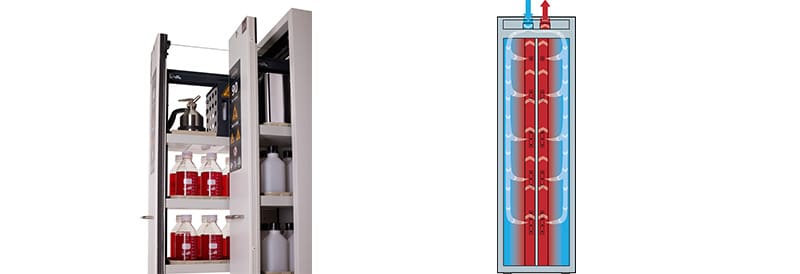
Another plus for day‑to‑day lab work: The vertical pull‑outs provide a quick overview of all containers and allow fast, ergonomic access from both sides. Both pull‑outs can also be opened simultaneously and, thanks to specially engineered slide rails, they run smoothly and quietly even at full load. An integrated self‑closing (soft‑close) damper also supports manual closing. These safety storage cabinets also stand out for their space‑efficient design: They are narrower but deeper than other solutions and thus make use of the previously unused space "behind the cabinet," for example, when installed flush to a fume hood. This makes them a perfect fit for standard lab furniture grids.
Ventilation Makes the Difference
Multi-Risk Safety Storage Cabinets have a ventilation concept that goes well beyond the requirements of EN 14470‑1. While the standard specifies 10 air changes per hour for cabinets storing flammable hazardous materials, a Multi-Risk Safety Storage Cabinet achieves 30 air changes per hour. This reliably prevents the formation of explosive atmospheres inside the cabinet and at the same time reduces corrosion of the interior fittings. A centrally mounted exhaust duct on the back wall ensures safe, even extraction at every storage level. This allows users flexibility in deciding where specific hazardous materials are placed within the cabinet. Air exchange can be reliably monitored with the optional safety assistance system (SAS).

Related Products

Catalog Number 17805814